
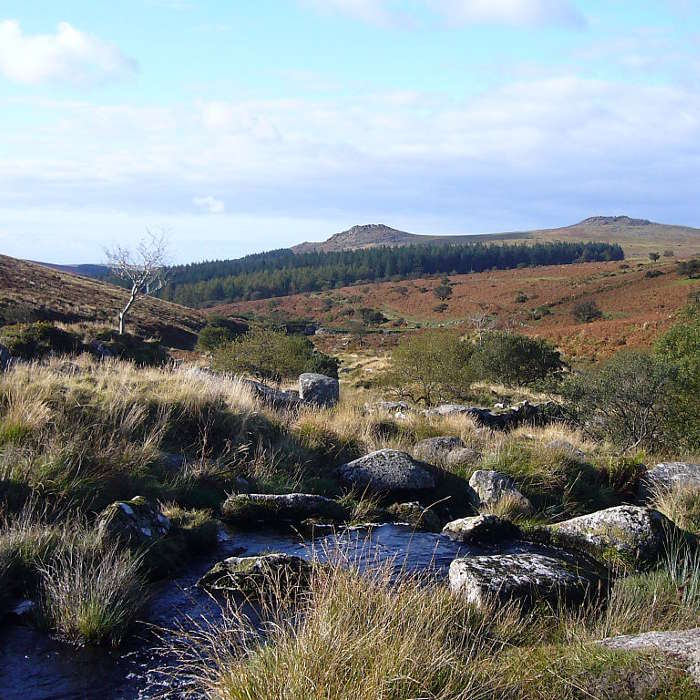
Dartmoor’s extensive upland moorland core rises above the surrounding small-scale, enclosed, predominantly pastoral landscape. Granite unites and characterises the entire National Character Area (NCA). On the moors the distinctive tors create key landscape features, interrupting otherwise unbroken skylines and ridges, and provide focal points for visitors. Isolated farmsteads and scattered villages utilise granite for buildings and walls; and the area’s strong time depth and rich cultural heritage are visually evident because of the granite, which includes the largest concentration of prehistoric stone rows in Britain.
The high moors are overlaid with thick deposits of peat and support internationally important blanket bogs surrounded by large expanses of upland heathland and grass moorland. The bogs and valley mires absorb and store significant amounts of water, as well as carbon, released into the 16 rivers and 8 reservoirs that supply the surrounding urban and rural populations and industry. As rivers leave the high moor they flow through deep-cut valleys steeped in woodland – both semi-natural broadleaved and coniferous plantation. The fast-flowing rivers, strewn with granite boulders, are popular for recreation, both passive and active.
http://publications.naturalengland.org.uk/publication/5098832853467136?category=587130
Agriculture continues to shape the landscape, as it has for thousands of years. Extensive grazing of the moorland commons by cattle, sheep and Dartmoor Ponies helps to manage the habitats and the large tracts of open access land. The surrounding enclosed land is an integral part of the upland farming system, providing ground for overwintering stock, hay meadows and winter feed crops.
Dartmoor provides a wealth of natural services, fresh water, carbon storage and food, as well as significant opportunity for recreation and access to areas with a high level of tranquillity. The challenge is to sustainably manage and enhance the natural assets that provide the services and opportunities. With 97 per cent of the NCA designated as a National Park, Dartmoor is well positioned to balance and manage these challenges and opportunities.
Statements of Environmental Opportunity
- SEO 1: Protect, manage and enhance Dartmoor’s extensive open moor, its sense of wildness and remoteness, the internationally important habitats and species it supports, and the carbon and water stored in its deep peat.
- SEO 2: Protect, manage and enhance Dartmoor’s rich cultural heritage and its strong connection with granite and associated minerals, providing inspiring information to promote understanding of the landscape.
- SEO 3: Protect, manage and enhance the enclosed, tranquil character of the pastoral landscape, encouraging the management of boundary features, including granite walls, and of semi-natural features to strengthen local distinctiveness and connectivity. Create opportunities for quiet, informal recreation, particularly around settlements.
- SEO 4: Protect and manage Dartmoor’s network of streams, leats and rivers; and enhance the contribution they make to landscape character, recreation and biodiversity, while managing water flows, quality and supply.
https://commons.wikimedia.org/wiki/File:View_to_Sharpitor_from_Meavy.JPG
Ecosystem services
Dartmoor NCA provides a wide range of benefits to society. Each is derived from the attributes and processes (both natural and cultural features) within the area. These benefits are known collectively as ‘ecosystem services’. The predominant services are summarised below.
Provisioning services (food, fibre and water supply)
Food provision: Over 40 per cent of the NCA is common land, which is almost entirely rough grazing for sheep, cattle and ponies. The remaining area is predominately pastoral (92 per cent of the farmed area is under grass), with grazing livestock – particularly sheep – the most significant farm type. While the productivity and profitability of hill farming is marginal, it is important for the management of land for biodiversity, water storage and regulation, climate regulation, recreation and sense of place.
Water availability: Dartmoor is a major area for water catchment in the southwest region, forming the source of many of Devon and east Cornwall’s rivers and supporting eight reservoirs. Dartmoor’s water supplies most of the surrounding populations, including Plymouth and Torbay and industry. The peat and blanket bogs that cover significant areas of the moors provide an important natural storage function, as well as regulating water flow and contributing to sense of place and biodiversity.
Genetic diversity: Dartmoor has three notable indigenous breeds: the Whiteface Dartmoor sheep, classified as at risk (900–1,500 breeding ewes); the Greyface Dartmoor sheep, classified as a minority breed (1,500–3,000 breeding ewes); and the Dartmoor Pony, classed as vulnerable (500–900 breeding mares). All three breeds are well adapted for surviving Dartmoor’s upland climate, and their grazing habits play a vital conservation role.
Regulating services (water purification, air quality maintenance and climate regulation)
Climate regulation: It is estimated that there is 9.7 Mt of carbon stored within the peat soils of Dartmoor (equivalent to one year’s carbon emissions from UK industry). Carbon storage is also provided by the woodlands (12 per cent of area). Appropriate management of the moorland area, preventing overgrazing, uncontrolled burns, drainage and erosion, can improve carbon capture, as can extending woodland cover where appropriate.
Regulating soil erosion: More than 30 per cent of the soils are peat based and prone to wind and water erosion, with risks of gullying/hagging. Old peat workings that have left significant areas of exposed peat in the central high moor are particularly prone to erosion. Erosion of peat reduces the area’s ability to store carbon and water and to support internationally important habitats. With the freely draining acid loamy soils over rock there is an enhanced risk of erosion on the moderately or steeply sloping land where cultivated or bare soil is exposed. This is exacerbated where organic matter levels are low after continuous arable cultivation or soil compaction. Severe weather – either unusually high levels of rainfall/high winds or drought – can increase the rate of soil erosion. Saturated soils result in increased run-off and, in extreme cases, gullying. Drought can lead to increased rates of poaching.
Regulating water quality: The majority of water in the NCA is classified as moderate or good quality. Degradation of peat soils and blanket bogs in the central moorland will reduce their ability to regulate water quality, impacting on river life downstream, including species such as salmon. The main threat to the quality of the water entering the reservoirs or at abstraction points is fire (especially wildfire). Appropriate vegetation management is essential to reduce this threat and to ensure effective and efficient capture of rain. Within the agricultural land surrounding the open moorland, key issues affecting water quality include soil and nutrient run-off, faecal contamination and pollution pathways on holdings. The woodlands, particularly the semi-natural woodlands on the steep valley sides, perform an important role in maintaining water quality by reducing soil and nutrient run-off.
Regulating water flow: The hard, steep and impermeable granite geology of the upper catchments means that river systems are very responsive to heavy rainfall (particularly in the winter months), affecting downstream locations in and outside the NCA4. Numerous key settlements are at risk of flooding within or on the periphery of the NCA. While Dartmoor’s granite is impermeable, the blanket bog that overlies it and surrounds the headwaters of all the river systems can hold water. A healthy blanket bog is able to store a large volume of water within saturated peat, releasing it slowly into rivers and streams and having a significant effect on reducing peak flows downstream. Blanket bog vegetation, when in good condition, can absorb significant quantities of water, which regulates runoff from the moor.
Cultural services (inspiration, education and wellbeing)
Sense of place/inspiration: Feelings of inspiration and escapism are popularly associated with the strong and varied landscape, one of sharp contrasts ranging from the wild, wind-swept moors with panoramic views to the sheltered, enclosed valleys and fringes of the NCA. The colours of the landscape, strong sense of remoteness within the heart of the NCA and views of prehistoric monuments all contribute to an inspiring and dramatic landscape. Dartmoor has been the inspiration for much art and literature over the centuries, including providing the settings for The Hound of the Baskervilles by Sir Arthur Conan Doyle and more recently the filming of War Horse, based on the book by Michael Morpurgo.
Sense of history: The landscape has a strong time connection, reflected in the abundance of sites and features: from bronze-age round houses and less regular boundary banks or ‘reaves’ and ceremonial stone rows, circles and burial chambers to industrial landscapes of spoil heaps and mine buildings. The history of upland farming can be traced in the pattern of lynchets, strong irregular field patterns characterised by drystone walls, stone-faced hedgebanks and hedges and larger rectilinear fields or ‘newtakes’. The historical character is further reinforced by a network of ancient roads and sunken lanes with hump-backed bridges connecting the moor to the villages and towns beyond, unified by the characteristic use of slate and granite. Dartmoor’s history is told through many myths and legends, as well as through the traditional fairs that still take place today, for example Widecombe Fair.
Tranquillity: The area is largely tranquil, a reflection of the sparsely settled upland landscape with few roads. Small areas of low tranquillity exist around the edge of the NCA, notably near main routes such as the A386, A38 and A30. Light pollution within the pastoral landscape is relatively low, particularly in the valleys and the narrow, high-hedged lanes away from towns and villages. Light pollution is also low on the moorland; however, the glow of more distant towns and cities is prominent from high ground.
Recreation: Dartmoor offers a huge recreational resource, used by significant numbers of people (2.3 million visitors per year). Some 97 per cent of the NCA is designated as a National Park; over 40 per cent is designated open access or common land; and there are more than 730 km of public rights of way (a density of 0.73 km per km²) and an additional 127 km of permissive paths. For cyclists there is the National Cycle Route around the western boundary, numerous offroad routes using tracks and disused railways, and a network of country lanes. The fast-flowing rivers provide challenges for kayakers, notably the Dart Loop, which attracts kayakers from across the UK. The rivers are also an important asset for fishing, walkers and families picnicking.
Biodiversity: Dartmoor is of European importance for its biodiversity, with 29 per cent of the area designated an SAC. Blanket bog covers 18 per cent of the NCA, the largest distribution in southern England; upland heathland accounts for 13 per cent and broadleaved woodland (broad habitat) 6 per cent. There are also relatively significant areas of species-rich neutral grassland. Dartmoor is notable for upland bird species, including the shrike and ring
ouzel, which are at the extreme southern edge of their European range. The red-backed shrike returned to Dartmoor in 2010 having been lost since 1970; it is on the International Union for Conservation of Nature Red List as a bird of top conservation concern. Many other priority species are present in the NCA, such as the bog hoverfly, marsh fritillary, Deptford pink and string-of sausages lichen.
Geodiversity: Dartmoor granite has shaped the historic landscape locally for several thousand years. Granite structures such as burial chambers are believed to date back to the early Neolithic (4000–2000 BC). The granite has been exploited commercially and used to build nationally important structures, for example Nelson’s Column in London. Metals such as tin, copper, lead and silver have all been mined on Dartmoor and have significantly contributed to the local economy. The china clay works in the south-western part of the NCA continue to be important in the local economy and in both national and international markets. China clays supply the paper, ceramics, plastics and numerous other industries that are now essential parts of our modern society. A large-scale tungsten and tin mine is due to open at Hemerdon.
http://publications.naturalengland.org.uk/file/5690370109210624


