
Wikipedia The carbon cycle is the biogeochemical cycle by which carbon is exchanged among the biosphere, pedosphere, geosphere, hydrosphere, and atmosphere of the Earth. Carbon is the main component of biological compounds as well as a major component of many minerals such as limestone. Along with the nitrogen cycle and the water cycle, the carbon cycle comprises a sequence of events that are key to make Earth capable of sustaining life. It describes the movement of carbon as it is recycled and reused throughout the biosphere, as well as long-term processes of carbon sequestration to and release from carbon sinks.
Humans have disturbed the biological carbon cycle for many centuries by modifying land use, and moreover with the recent industrial-scale mining of fossil carbon (coal, petroleum and gas extraction, and cement manufacture) from the geosphere. Carbon dioxide in the atmosphere had increased nearly 50% over pre-industrial levels in 2020, forcing greater atmospheric and Earth surface heating by the Sun. The increased carbon dioxide has also increased the acidity of the ocean surface by about 30% due to dissolved carbon dioxide, carbonic acid and other compounds, and is fundamentally altering marine chemistry. The majority of fossil carbon has been extracted over just the past half century, and rates continue to rise rapidly, contributing to human-caused climate change. The largest consequences to the carbon cycle, and to the biosphere which critically enables human civilization, are still set to unfold due to the vast yet limited inertia of the Earth system. Restoring balance to this natural system is an international priority, described in the both the Paris Climate Agreement and Sustainable Development Goal 13.
- Hits: 1343
Wikipedia In ecology and Earth science, a biogeochemical cycle or substance turnover or cycling of substances is a pathway by which a chemical substance moves through biotic (biosphere) and abiotic (lithosphere, atmosphere, and hydrosphere) compartments of Earth. There are biogeochemical cycles for the chemical elements calcium, carbon, hydrogen, mercury, nitrogen, oxygen, phosphorus, selenium, iron and sulfur; molecular cycles for water and silica; macroscopic cycles such as the rock cycle; as well as human-induced cycles for synthetic compounds such as polychlorinated biphenyl (PCB). In some cycles there are reservoirs where a substance remains for a long period of time.
Biogeochemical cycle - Wikipedia
- Hits: 1165
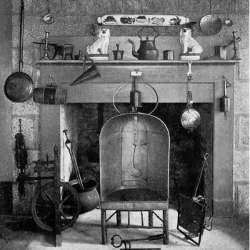
In these days of rapid changes and improvements, of universal education, and of ever-increasing facilities in the means of transport and communication, in even the most remote country districts the old order is rapidly changing and giving place to the new, and all things old are being ruthlessly swept away, and are disappearing one after another.
Although at the present time a considerable number of old farm-houses are still standing in Devon, much (at least as regards their outward appearance) as they stood from one to four or even five hundred years ago, yet in every year that passes one sees a marked decrease in their number, either from accident or by design. For on the one hand, owing to the dryness of their thatched roofs, their cob-walls, and their well-seasoned and often worm-eaten timber-work, they fall an all too easy prey to the demon of fire. While, on the other hand, many are yearly being condemned by the Medical Officers of Health, and rightly so, as “no longer fit for human habitation”, owing to the wilful neglect in some cases, and the inability through lack of means in others, of their owners to keep them in habitable repair.
Full title: The Old Devon Farm-House. Part I. Its Exterior Aspect and General Construction. by Charles H. Laycock.
(Read at Totnes, 21st July, 1920. Year published: 1920; Origin: DA Transactions; Pages: 158-191)
https://devonassoc.org.uk/devoninfo/the-old-devon-farm-house-part-i-1920/
Social Media:
Facebook: https://www.facebook.com/TheDevonshireAssociation (448)
Twitter: https://twitter.com/devonassoc (480) https://twitter.com/DABuildings (787)
- Hits: 1777
On the 22nd May 2019, members of the Devon Climate Emergency Response Group endorsed the underlying principles of the Devon Climate Declaration.
All organisations are encouraged to sign the Declaration to show the growing support for taking action.
- This Declaration has been prepared by a consortium of public, private and voluntary organisations collaborating through a Devon Climate Emergency Response Group. It sets out an ambition to tackle climate change that covers all of Devon, including those people who live, work in and visit our county, and those businesses who are based or operate here.
- We are aware of the significant implications of climate change for Devon’s communities; it is already affecting our environment, infrastructure, economy and health & wellbeing. If not addressed, the impact on future generations will be profound and the ability to meet the United Nation’s Sustainable Development Goals will be severely compromised.
- We understand that the Intergovernmental Panel on Climate Change (IPCC) has advised that carbon emissions must reduce globally by at least 45% by 2030 from 2010 levels and reach net-zero by 2050 if we are to avoid the worst effects of climate change by keeping warming below 1.5 degrees.
- We will lead in the global response to climate change through our collective action, innovation and influence.
- Individually, we will review (within 6 months) our plans to reduce our organisation’s carbon emissions to meet or exceed these targets, including ensuring the people we do business with are doing the same. We will publicly report our carbon emissions annually in accessible formats.
- In collaboration, we will engage Devon’s residents, businesses and visitors to develop and implement a plan to facilitate the reduction of Devon’s production and consumption emissions to meet IPCC recommendations at the latest. We will openly report progress on its delivery. We know this transformational change will be challenging and will include:
- Deploying more renewable, decentralised and smart energy systems
- Retrofitting energy-efficiency measures into our existing buildings
- Constructing zero-carbon new buildings
- Travelling less and using improved walking, cycling and public transport infrastructure more often, and using electric and hydrogen vehicles
- Changing our consumption to use less, re-use more and choose low-carbon options
- Challenging all economic sectors to review their practices and the values of those they do business with
- Divesting from fossil fuels
- Changing our dietary patterns and reducing food waste
- Changing agricultural practices to reduce emissions associated with farming operations, manage soils sustainably and replenish soil carbon
- Encouraging carbon storage such as through tree planting, the use of wood in construction and peatland restoration
- Empowering the people of Devon with the knowledge and skills to act collectively.
- Additionally, we will work to understand the near-term and future risks of climate change for Devon to plan for how our infrastructure, public services and communities will have to adapt for a 1.5-degree warmer world.
- Local organisations and communities cannot do this alone as the national government plays a key role in many of the policy areas that are vital to reducing emissions and adapting to climate change. We call on the government to prioritise decarbonisation and adaptation within decision making and work with us by using its powers to provide the resources and funding necessary to accelerate the transition to a low-carbon and resilient economy and society.
- We challenge every organisation, business, community and individual to do the same.
https://www.devonclimateemergency.org.uk/devon-climate-declaration/
On 4th September 2020, Hartstongue signed the Devon Climate Declaration, and we encourage others to do the same.
- Hits: 1310
The Great Green Wall is an African-led movement with an epic ambition to grow an 8,000km natural wonder of the world across the entire width of Africa.
A decade in and roughly 15% underway, the initiative is already bringing life back to Africa’s degraded landscapes at an unprecedented scale, providing food security, jobs and a reason to stay for the millions who live along its path.
The Wall promises to be a compelling solution to the many urgent threats not only facing the African Continent, but the global community as a whole – notably climate change, drought, famine, conflict and migration.
Once complete, the Great Green Wall will be the largest living structure on the planet, 3 times the size of the Great Barrier Reef.
https://www.greatgreenwall.org/about-great-green-wall
Social Media:
Facebook: https://www.facebook.com/GreenWallAfrica/ (7.4k)
Twitter: https://twitter.com/GreenWallAfrica (4.3k)
Instagram: https://www.instagram.com/greatgreenwallafrica/ (4.2k)
- Hits: 1766
On the 12th August we launched the campaign for the Climate and Ecological Emergency (CEE) bill. This is a Private Members’ Bill, and taking it through parliament will be a hard-fought process but it has been done before with major climate legislation. This is an alliance bill that has been written by scientists, lawyers and activists; it is gathering support from a broad range of campaign groups, businesses, charities and individuals. The bill has the potential to become the most significant move forward since the Climate Change Act 2008.
Social Media:
Facebook: https://www.facebook.com/CEEbillNOW/ (145)
Twitter: https://twitter.com/CEEbill_NOW (1.8k)
YouTube: https://www.youtube.com/channel/UCeXPU-aKiM8NjIcVCIdEF5w (78)
- Hits: 1448


