
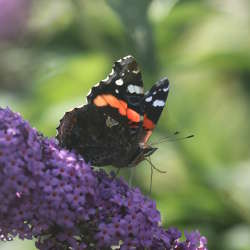
Devon Wildlife Trust The red admiral is an unmistakeable garden visitor. This black-and-red beauty may be seen feeding on flowers on warm days all year-round. Adults are mostly migrants, but some do hibernate here. A fairly large black, white and red butterfly, the red admiral is an impressive visitor to our gardens where it can be spotted feeding on buddleia and other flowers. It will also frequent all kinds of other habitats, from seashores to mountains! Adults sometimes hibernate, and may be seen flying on warm days throughout the year, although they are most common in the summer and early autumn. The caterpillars feed on common nettles.
How to identify
The red admiral is mainly black, with broad, red stripes on the hindwings and forewings, and white spots near the tips of the forewings.
https://www.devonwildlifetrust.org/wildlife-explorer/invertebrates/butterflies/red-admiral
- Hits: 1709

Devon Wildlife Trust The large skipper is a small, orange butterfly, similar to the small skipper. Adults fly between June and August, when they can often be seen resting in sunny positions and long grass, or feeding on flowers such as bramble. Large skippers can be found on rough grassland and sand dunes, along roadside verges and woodland edges, in large gardens, or anywhere else with plenty of grasses. They lay their eggs on grass blades. Foodplants of the caterpillars include cock's-foot, purple moor-grass and false broom.
How to identify
The large skipper has russet-brown wings edged with large, dark brown patches and dotted with small, light orange patches. This pattern helps distinguish them from the small and Essex skippers. Males have a small black stripe in the middle of their forewings.
https://www.devonwildlifetrust.org/wildlife-explorer/invertebrates/butterflies/large-skipper
- Hits: 1454
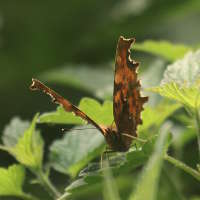
Devon Wildlife Trust The comma is a medium-sized orange-and-brown butterfly. It gets its name from the comma-shaped white spots on the underneath of its wings. It is on the wing throughout the year, having several broods and overwintering as an adult. It is a common and widespread butterfly of woodland edges, particularly during the spring and autumn. The caterpillars feed on common nettles, elms and willows.
They have brown and white flecks that make them look like bird-droppings and help to camouflage them.
How to identify
The comma is unmistakeable: ragged, orange wings with brown spots distinguish it from similar species. Its underside has cryptic brown colouring, making it look like a dead leaf.
https://www.devonwildlifetrust.org/wildlife-explorer/invertebrates/butterflies/comma
- Hits: 1482

Devon Wildlife Trust The dazzling silver-studded blue is a rare butterfly of heathland habitats, mainly in southern England. It has undergone severe population declines in recent years. The silver-studded blue emerges in June and is usually on the wing until late August. It is a rare butterfly, generally found in heathland habitats that have shorter, sparsely vegetated areas. It is restricted to close-knit colonies in southern England and Wales. Two subspecies can be found in its range, while two others are now extinct in the UK. The larvae feed on a wide variety of plants, such as Bell Heather, Cross-leaved Heath and gorses.
How to identify
The silver-studded blue is a small butterfly which gets its name from the light blue reflective 'studs' (scales) found on the underside of the wings. The upper wings are blue with a dark outer rim. Males are bluer than females, which are more of a dull brown.
https://www.devonwildlifetrust.org/wildlife-explorer/invertebrates/butterflies/silver-studded-blue
- Hits: 1740
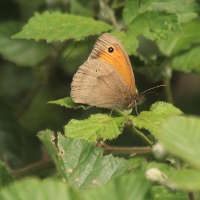
Devon Wildlife Trust The medium-sized meadow brown is one of the commonest grassland butterflies, on the wing in the summer, from June to September. It also occurs in parks, gardens and cemeteries. It even flies in dull weather when other butterflies are inactive. Adults can be seen in large numbers, flying low over the grass and flowers. Caterpillars feed on a variety of grasses such as fescues, bents and meadow-grasses.
How to identify
The meadow brown is mainly brown with washed-out orange patches on the forewings. The best way to identify the 'brown' butterflies is by looking at the eyespots on their wings. The combination of its relatively large size, orange patches on the forewings only, one eyespot on the forewing and none at all on the hindwings, is unique to the meadow brown. The meadow brown also has only one small white 'pupil' in the eyespots, instead of two like the gatekeeper.
https://www.devonwildlifetrust.org/wildlife-explorer/invertebrates/butterflies/meadow-brown
- Hits: 1410
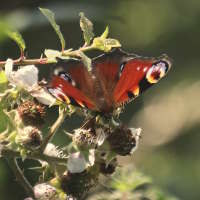
Devon Wildlife Trust A strikingly beautiful, red butterfly, so-named for the large blue and yellow 'eyes' on each upperwing that bare a marked resemblance to the tail feathers of a peacock. It is on the wing throughout the year, having a single brood, and overwinters as an adult. A very common butterfly, the peacock is a regular visitor to our gardens where it feeds on buddleia and other flowers. It ranges far, however, and can also be found in the shelter of woodland rides and clearings. The caterpillars feed on common nettles.
How to identify
Perhaps our most familiar butterfly, the peacock is deep-red with black spots and blue 'eyespots' on both the forewings and hindwings. Its underside is dark brown, making the wings look like dead leaves.
https://www.devonwildlifetrust.org/wildlife-explorer/invertebrates/butterflies/peacock
- Hits: 1421

Devon Wildlife Trust The Beautiful demoiselle is a large damselfly that lives on small, fast-flowing rivers, mainly in the west of the country. It is one of only two UK damselflies with obviously coloured wings; the similar-looking Banded demoiselle, however, has distinctive dark patches on its wings. The Beautiful demoiselle is typically on the wing from May to August. It displays a flitting, fluttering flight, which the male uses to attract a female.
How to identify
Male Beautiful demoiselles have dark-coloured wings and metallic blue-green bodies; females have brown wings and green bodies. The Beautiful demoiselle is similar to the Banded Demoiselle, but the males of the latter species have distinctive dark patches in the middle of their wings.
https://www.devonwildlifetrust.org/wildlife-explorer/invertebrates/damselflies/beautiful-demoiselle
- Hits: 1671
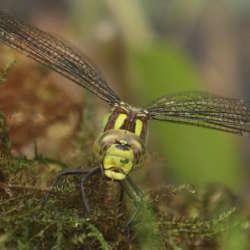
Devon Wildlife Trust The Southern hawker is a large hawker dragonfly that is on the wing from the end of June through to October. A common dragonfly of ponds, lakes and canals in the lowlands, particularly near to woodland, it can be seen patrolling a regular patch of water when hunting, or often 'hawking' through woodland rides. Hawkers are the largest and fastest flying dragonflies; they catch their insect-prey mid-air and can hover or fly backwards.
How to identify
The Southern hawker is mostly black in colour. The male has lime green spots all along the body, pale blue bands on the last three segments of the abdomen, blue-green eyes, and large green patches on the thorax. The female is paler, with pale green spots and brownish eyes. The black-and-blue hawkers are a tricky group of dragonflies to identify. The Southern hawker can be recognised by its lime green, rather than blue, spots and the large pale patches on its thorax.
https://www.devonwildlifetrust.org/wildlife-explorer/invertebrates/dragonflies/southern-hawker
- Hits: 1476

Devon Wildlife Trust There are nine species of pond skater in the UK, which range between 1-2cm in length. Often seen in large groups, they 'skate' around on the surface of the water in ponds, lakes, ditches and slow-flowing rivers, feeding on smaller insects which they stab with their sharp mouthparts or 'beaks'. The Common pond skater emerges from hibernation in April and lays its eggs. Hatching soon after, the nymphs go through a number of moults.
How to identify
The brownish-black, long-legged Common pond skater is only likely to be confused with the smaller, thinner, more fragile-looking Common water-measurer, or the smaller, chunkier, shorter-legged Water cricket.
https://www.devonwildlifetrust.org/wildlife-explorer/invertebrates/bugs/common-pond-skater
- Hits: 1159
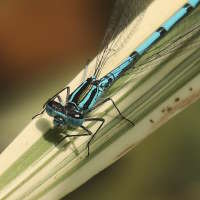
Devon Wildlife Trust The Azure damselfly is a small blue damselfly that is very common around most waterbodies and can also be found away from breeding sites in grassland and woodland. It is on the wing from the end of May through to September. Damselflies do not fly as strongly as dragonflies, so tend to lay in wait for their insect prey before catching it in mid-air with their legs. They will return to their perch to eat their prey.
How to identify
The Azure damselfly is pale blue with bands of black along the body. To identify the small blue damselflies, of which there are seven species in the UK, it helps to concentrate on the pattern on the second segment of the males' abdomen, just behind the thorax. In the Azure damselfly, this segment is blue with a black U-shape.
https://www.devonwildlifetrust.org/wildlife-explorer/invertebrates/damselflies/azure-damselfly
- Hits: 1215


