
Devon Wildlife Trust A common and familiar bird, the pied wagtail is often seen in towns and cities, dashing across lawns, roads and car parks while wagging its long tail up and down. Pied wagtails eat insects, but will feed on seeds and even rubbish in winter. They flock together at warm roost sites like reedbeds and sewage works or trees and bushes in city centres. In summer, they defend breeding territories and will nest in ivy, under roofs, in walls, between stones ... in all kinds of places!
How to Identify
The pied wagtail is a familiar black-and-white bird, with a white face, white belly and white bars on the wings. The other two breeding species of wagtail in the UK both have yellow underparts.
RSPB The pied wagtail is a delightful small, long-tailed and rather sprightly black and white bird. When not standing and frantically wagging its tail up and down it can be seen dashing about over lawns or car parks in search of food.
It frequently calls when in its undulating flight and often gathers at dusk to form large roosts in city centres.
https://www.rspb.org.uk/birds-and-wildlife/wildlife-guides/bird-a-z/pied-wagtail/
Devon Birds: Search the Devon Birds website for recent sightings of Pied Wagtails in Devon.
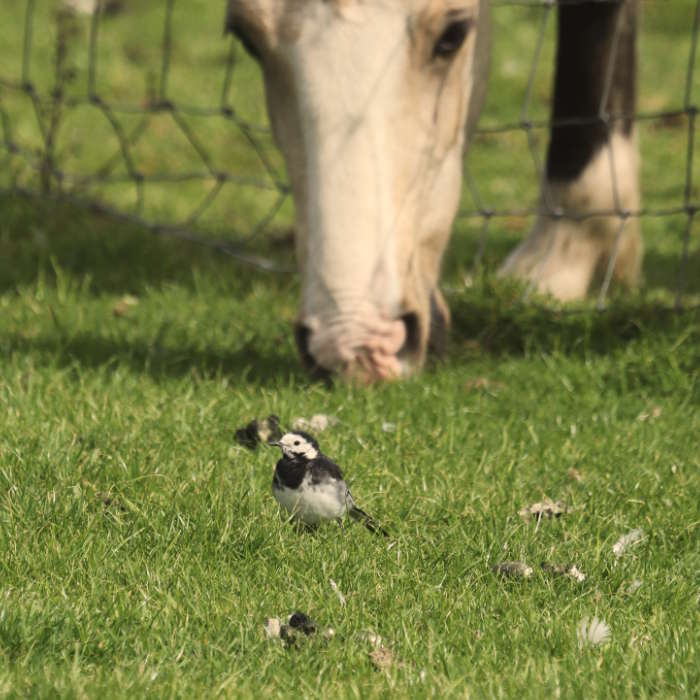
Female? Pied Wagtail, St Helen's Field, Lundy 28th August 2020 photo by Grant Sherman
Wikipedia: The white wagtail (Motacilla alba) is a small passerine bird in the family Motacillidae, which also includes pipits and longclaws. The species breeds in much of Europe and the Asian Palearctic and parts of North Africa. It has a toehold in Alaska as a scarce breeder. It is resident in the mildest parts of its range, but otherwise migrates to Africa. In Ireland and Great Britain, the darker subspecies, the pied wagtail or water wagtail (M. a. yarrellii) predominates. In total, there are between 9 and 11 subspecies.
The white wagtail is an insectivorous bird of open country, often near habitation and water. It prefers bare areas for feeding, where it can see and pursue its prey. In urban areas it has adapted to foraging on paved areas such as car parks. It nests in crevices in stone walls and similar natural and man-made structures.
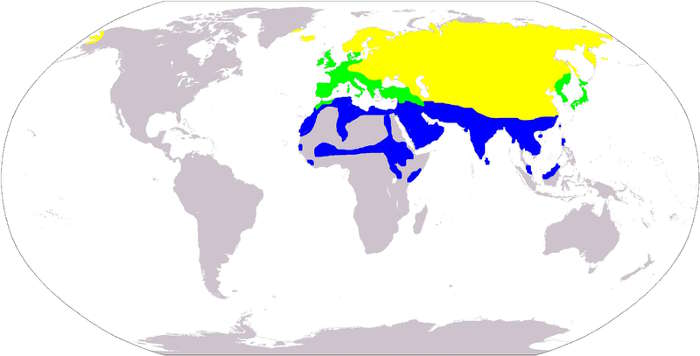
White Wagtail distribution: Yellow - Summer, Green - Resident, Blue - Winter
https://commons.wikimedia.org/wiki/File:White_wagtail_distribution.PNG
https://en.wikipedia.org/wiki/White_wagtail
eBird: Distinctive but variable: all plumages are some bold combination of black, white, and grey. Shows considerable variation in plumage across the world, but never has a clear, thin and contrasting eye-brow like White-browed or Japanese Wagtail. Occurs in varied open habitats, from wild grassy areas and wetlands to paved car parks and grassy lawns. Usually seen as singles, pairs, or small groups walking and running around, pumping the long, white-sided tail up and down. Identified easily in flight by its loud, thick and distinctive “tsee-tsee’ call.



