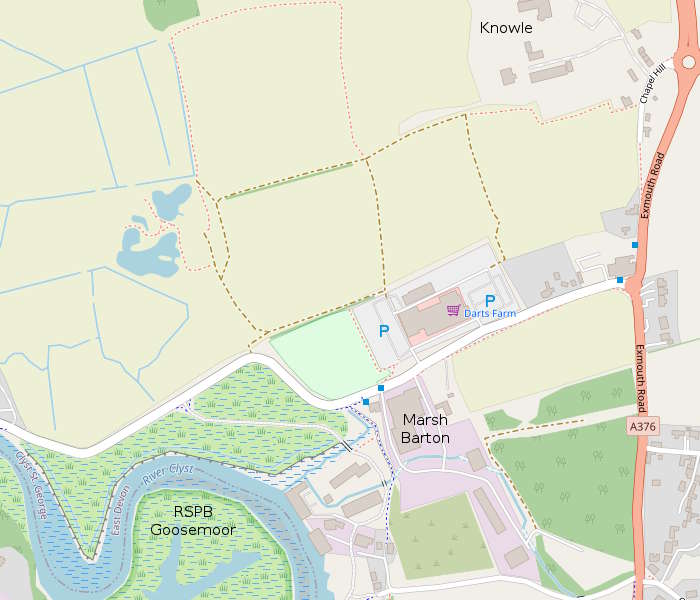
Marsh Barton Farm is now the site of Dart's Farm and Dart Fresh, but how has the land use changed of the past 180 years?
The parish of Clyst St George was surveyed in 1839. This extract from the Devon Historic Environment website shows the area around Marsh Barton. I've added the field names to show how the fields were used back then. Most of this land was owned by Alexander Hamilton Hamilton Esquire and occupied by John Hellier.
1839 - Tithe Map
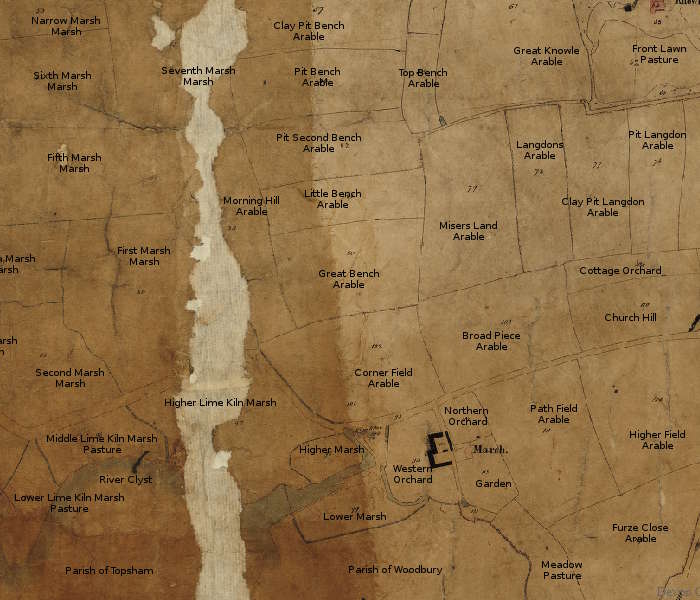
Alexander Hamilton Hamilton Esq. owned all the Clyst St George land in the map except the Front Lawn of Knowle, the residence of Samuel Parr Esq. Mr Hamilton also owned Goosemoor in the parish of Topsham which is now an RSPB reserve.
The tithe maps and apportionments are an important source of information about the history and topography of a parish. They provide details of land ownership and occupation, and the type of cultivation of the land, and are often the earliest complete maps of parishes. They were produced in order to assess the tithe payable in cash to the parish church for the support of the church and its clergy. This tithe had been paid in kind until The Commutation Act was passed in 1836, when it was agreed that this should be converted to a monetary payment.
A survey of the whole of England and Wales was undertaken in the decade or so after 1836, to establish the boundaries of each parish, and assess the amount of tithe due for each parcel of land within it. This resulted in the survey of all tithe-able land in each parish, the production of a map covering the whole parish and a reference book (apportionment) identifying each plot of land. Note that in a few cases, no tithe map was made for the parish, because the land within it was not subject to tithes.
https://www.devon.gov.uk/historicenvironment/tithe-map/
1850 - White's Devonshire Directory
"CLIST ST. GEORGE, or Clyst St. George, is a scattered village also known as Clyst Wick. A parish in East Budleigh Hundred, the Archdeaconry and the Diocese of Exeter, 1½ miles E by N. of Topsham, and 4 miles S.E. of Exeter, it has 370 inhabitants, and 1001 acres of land. It is the most southern of the six Clyst parishes, in the valley of the small river Clist, or Clyst, which falls into the Exe at Topsham. J.B. Cresswell Esq., is lord of the manor, which was anciently held by the Champernownes, who had a seat here.; as also had the Sukespie, or Sokespitch family. Alex. H. Hamilton, Esq., owns the estate which belongs to the latter, and the other principal owners are J. Daw and H. Porter, Esqrs.
The Church (St. George) is an ancient structure, with a tower and three bells. The rectory, valued in K.B. at £17. 16s. 8d.,and in 1831 at £350, is in the patronage and incumbency of the Rev. R.W. Ellicombe, M.A., who has 8A. 1R. 18p. of glebe, and a large brick residence. . The Free School for 50 poor children is endowed with a house and 22 acres of land at Woodbury and Ottery St Mary left by Lady Hannah Seward , relict of Sir Edward Seaward, Knight. The schoolmaster has also £3 a year from Weare's Charity.
Clyst Agricultural Association (for eighteen parishes,) has a numerous list of subscribers, and distributes early a great number of prizes for the encouragement of improvements in agriculture, and skill and industry among labourers and their families.
RESIDENTS George Baker , shopkeeper James Bower, blacksmith James Bradford, tailor James Brown, corn miller, Marsh Mills William Chaplin, shopkeeper Rev. Thomas Clarke, curate Rev John Frederick Doveton, LL.B, Carisfield Rev. William Rous Elliscombe, MN.A. The Rectory Elizabeth Gove, victualler, The George and Dragon John Mawditt. wheelwright James Palmer, carpenter Samuel Parr, Esq. Knowle John Potter, shoemaker William Reade, auctioneer Robert Skinner, parish Clerk William Stokes, butcher Thomas Voyser, shopkeeper Mr Thomas Warren Charles Alexander Westcott, artist. FARMERS John Ellier, Marsh Barton John May, Hollin Bush John Page ( and butcher) Clay Pit Henry Pidsley, Court Samuel Roach, Old Winslade John Shilles, Kenniford Thomas Warren, junior.
http://www.devonheritage.org/Places/Clyst%20St%20George/ClystStGeorgeinWhitesDirectoryof1850..htm
1881 - United Kingdom Census
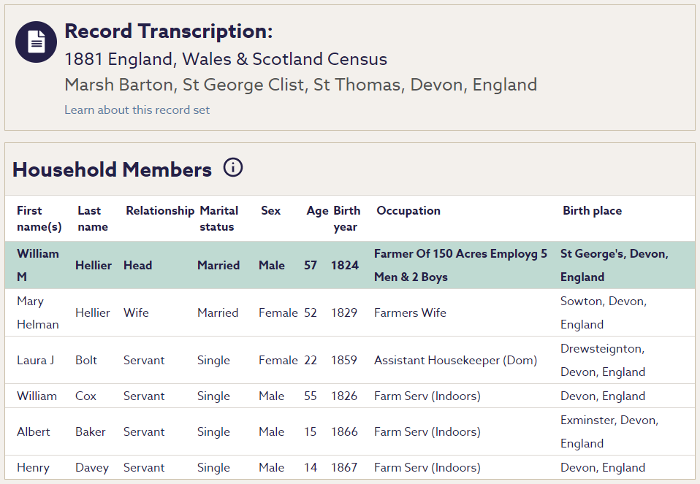
https://www.findmypast.co.uk/transcript?id=GBC%2F1881%2F0009731559
https://en.wikipedia.org/wiki/1881_United_Kingdom_census
1957 -
Dart Fresh was started as a wholesale fruit and vegetable merchant by Colin Dart as C.J. Dart Exeter. Geoff Pritchard joined the business one month later.
https://www.dartfreshproduce.co.uk/
1971 - Pic Fresh
It all started with our father, Ronald Dart, back in 1971 when he started one of Britain’s first pick-your-own businesses; Pic Fresh. Long before it became fashionable, he believed that we should eat what is in season and produced as locally as possible.
https://dartsfarm.co.uk/about/our-story
1982 - Dart's Farm
In 1982, Ronald passed away and the newspapers said ‘Death of a Pioneer’. It was then that Ronald’s three sons, Michael, James and Paul, returned home to create ‘Darts Farm’; the place as we know it today. Following on from what their father started, with the same ethos and family values, the three Dart brothers further developed Darts Farm creating a vibrant, nationally award-winning farm shop overlooking the beautiful Clyst Valley.
The working farm, run by Paul, the eldest of the brothers, is still at the heart of the business. Using traditional farming methods and centuries old rotational practices means that their rich, red Devon soil is full of life and fertility. Each morning the farm team go out to the fields and hand pick fresh seasonal fruit and veg to sell direct through the farm shop. During the summer months, their native herd of Ruby Red Devon cattle graze on the River Clyst Meadows.
Michael and James Dart had a vision to create a unique shopping destination that champions local food and drink, from the farm and other incredible, passionate artisans; they wanted it to be about the home and the great outdoors; to be somewhere that you are able to go and spend the whole day. You can reconnect with nature by visiting the animals, winding your way through the vegetable fields, or wildlife spotting in the bird hide overlooking the wetlands. If you are feeling adventurous you can hire a bike and discover the beautiful views the Exe Estuary has to offer.
1987 - Farmhouse listed
2 dwellings, formerly a single farmhouse. Possibly C16, but much altered.
Roughcast cob, on stone footings, with gabled-end and hipped roof. Probably a 3-room, through-passage house, the lower end to the right of the passage, with a front parlour wing, 2 rooms in length. 2 storeys.
Front: 3-window range, with 3-light casement windows to first floor, similar windows to hall and service end. Two 3-light windows to each floor of inner face of parlour wing, with a central doorway with glazed porch. C19 and C20 fenestration elsewhere. An impressive array of chimney stacks is the buildings most conspicuous feature: there are 6 in all, all rendered; 3 axial (or almost axial) + 2 end stacks, and 1 lateral stack to the wing. It is difficult to be certain which of these stacks are original; that backing onto the passage is entirely C20.
Interior: some roughly chamfered ceiling beams, and a chamfered lintel to hall fireplace. C18 pegged roof to wing. The house is of considerable historical interest, as it was the home of the Sokespitch family from the middle of the C12 to the late C18; they gradually reclaimed the surrounding marshland and have been the subject of a study by W G Hoskins, Old Devon (1966, reprinted 1971), pp. 121-34.
https://britishlistedbuildings.co.uk/101334012-marsh-barton-farmhouse-clyst-st-george
2020