Saint David (Welsh: Dewi Sant; Latin: Davidus; c. 500 – c. 589) was a Welsh bishop of Mynyw (now St Davids) during the 6th century. He is the patron saint of Wales. David was a native of Wales, and a relatively large amount of information is known about his life. His birth date, however, is uncertain: suggestions range from 462 to 512. He is traditionally believed to be the son of Saint Non and the grandson of Ceredig ap Cunedda, king of Ceredigion. The Welsh annals placed his death 569 years after the birth of Christ, but Phillimore's dating revised this to 601.
https://en.wikipedia.org/wiki/Saint_David
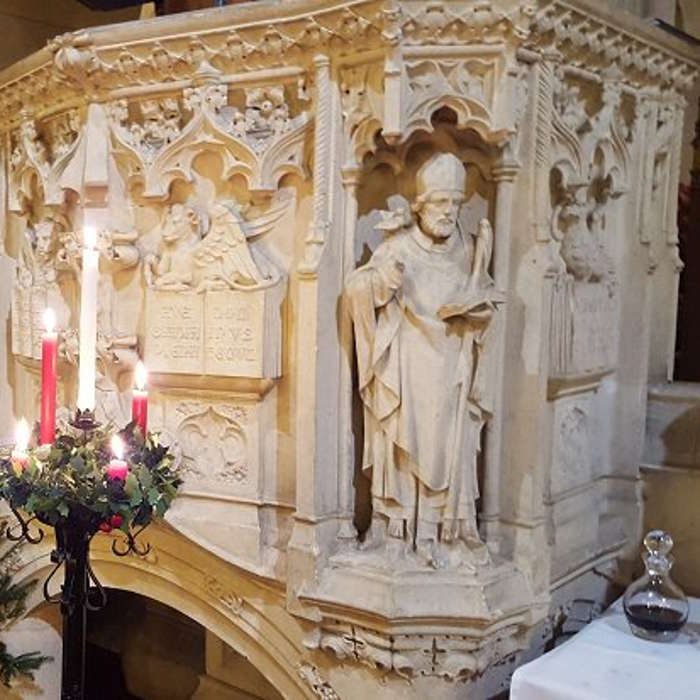
https://twitter.com/StDavids_Exeter/status/945255614724345857/photo/4
Many of the traditional tales about David are found in the Buchedd Dewi ("Life of David"), a hagiography written by Rhygyfarch in the late 11th century. Rhygyfarch claimed it was based on documents found in the cathedral archives. Modern historians are sceptical of some of its claims: one of Rhygyfarch's aims was to establish some independence for the Welsh church, which had refused the Roman rite until the 8th century and now sought a metropolitan status equal to that of Canterbury. (This may apply to the supposed pilgrimage to Jerusalem where he is said to have been anointed as an archbishop by the patriarch.)
The tradition that he was born at Henfynyw (Vetus-Menevia) in Ceredigion is not improbable. He became renowned as a teacher and preacher, founding monastic settlements and churches in Wales, Dumnonia, and Brittany. St David's Cathedral stands on the site of the monastery he founded in the Glyn Rhosyn valley of Pembrokeshire. Around 550, he attended the Synod of Brefi, where his eloquence in opposing Pelagianism caused his fellow monks to elect him primate of the region. As such he presided over the synod of Caerleon (the "Synod of Victory") around 569.
His best-known miracle is said to have taken place when he was preaching in the middle of a large crowd at the Synod of Brefi: the village of Llanddewi Brefi stands on the spot where the ground on which he stood is reputed to have risen up to form a small hill. A white dove, which became his emblem, was seen settling on his shoulder. John Davies notes that one can scarcely "conceive of any miracle more superfluous" in that part of Wales than the creation of a new hill. David is said to have denounced Pelagianism during this incident and he was declared archbishop by popular acclaim according to Rhygyfarch bringing about the retirement of Dubricius. St David's metropolitan status as an archbishopric was later supported by Bernard, Bishop of St David's, Geoffrey of Monmouth and Gerald of Wales.
The Monastic Rule of David prescribed that monks had to pull the plough themselves without draught animals, and must drink only water and eat only bread with salt and herbs. The monks spent their evenings in prayer, reading and writing. No personal possessions were allowed: even to say "my book" was considered an offence. He lived a simple life and practised asceticism, teaching his followers to refrain from eating meat and drinking beer. His symbol, also the symbol of Wales, is the leek.